
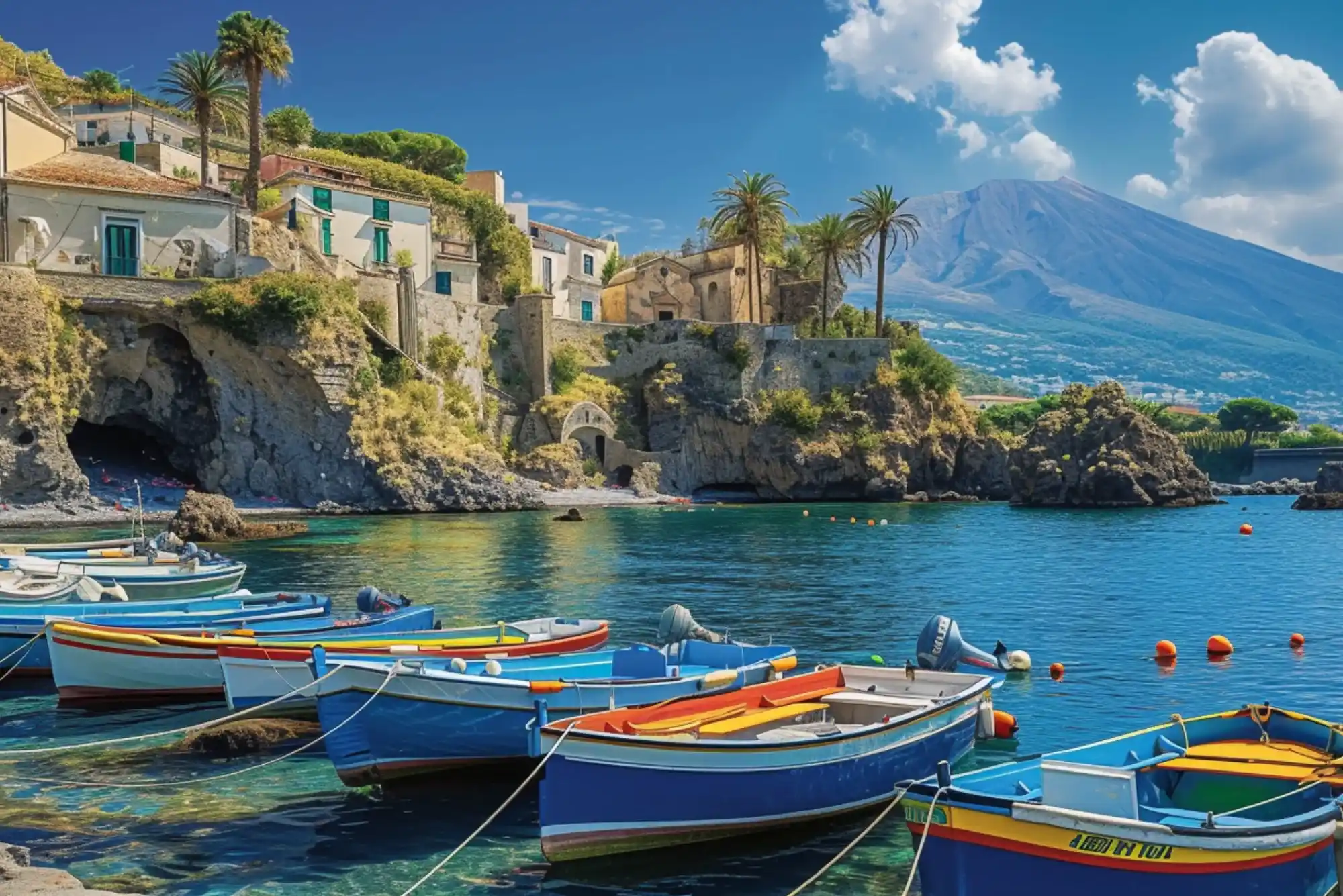
Sicily: Complete Guide to Holidays, Etna Excursions, and UNESCO Baroque
Sicily, known in antiquity by the toponym Trinacria due to its peculiar triangular geographic configuration, represents much more than a mere insular entity, configuring itself instead as a continental microcosm situated in the Mediterranean basin. Planning Holidays in Sicily means immersing oneself in a territory characterized by marked contrasts and complex harmonies: the coexistence of Europe’s most imposing active volcanic apparatus, with its snowy and igneous manifestations, and the typically Mediterranean climate of the southern coastal strip; the historical stratification that features the cohabitation of Greek-era temple architecture and Norman-era cathedrals; and a culinary heritage that testifies to millennia of cultural interactions and dominations.
Planning an itinerary across Sicily requires a thoughtful approach, given the vastness and complexity of the available heritage. From metropolitan areas, dense with historical evidence like Palermo, to the expressions of Sicilian Baroque in the Val di Noto, right through to the natural environment of Mount Etna, the island necessitates adequate time for thorough exploration. The present document is intended as an analytical guide for scholars and interested visitors, focusing on the destinations of major relevance and the most significant experiences offered by Eastern and Western Sicily, with a specific focus on the Mount Etna volcanic system.
I. Cultural Stratification: UNESCO Sites and Historical Routes
The historical relevance of Sicily derives from its geostrategic position, serving as a fundamental hub for maritime routes between Europe, Africa, and Asia. Over the course of three millennia, the island has been the stage for settlements by Sicani, Siculi, Phoenicians, Greeks, Romans, Byzantines, Arabs, Normans, Swabians, Angevins, and Aragonese. Each of these civilizations left an indelible mark, contributing to the formation of a cultural heritage of universal value.
Magna Graecia and Classical Testimonies
The period of maximum splendour in antiquity is attributable to the Greek colonization (8th century BC), which established Sicily as the nerve center of Magna Graecia.
Agrigento and the Valley of the Temples: An emblem of this period is the Valley of the Temples in Agrigento, a UNESCO World Heritage site. Visiting the archaeological site, particularly during the evening hours, allows observation of the Temple of Concordia (in an excellent state of preservation), the Temple of Juno, and the ruins of the Temple of Zeus. The imposing Doric columns bear witness to the magnificence of ancient Akragas, which was once one of the most prosperous poleis in the Mediterranean.
Syracuse and Greek Hegemony: Ancient Syracuse distinguished itself as the most powerful of the Greek colonies, even rivalling Athens. The Neapolis Archaeological Park hosts the majestic Greek Theatre, still used for classical performances today, and the Ear of Dionysius, an artificial cave known for its peculiar acoustic properties. The current historical center, located on the Island of Ortigia, exhibits complex architectural stratification, exemplified by the Cathedral, which incorporates the structures of the ancient Temple of Athena.

The Arab-Norman Syncretism in Palermo
In Palermo, the Arab and Norman influences merge into a cultural synthesis of exceptional value. The Normans, under the reign of Roger II, consolidated a state that integrated Western construction techniques with Islamic and Byzantine art and decoration.
The UNESCO Itinerary: The Palatine Chapel, located inside the Norman Palace, is considered an absolute masterpiece: its walls and ceiling are covered with Byzantine mosaics depicting biblical scenes, while the wooden ceiling features complex muqarnas decorations of Islamic style. The nearby Palermo Cathedral is a building that testifies to the superposition of different architectural styles, including Gothic, Moorish, and Neoclassical elements. The historical markets of Palermo – Ballarò, Vucciria, and Capo – represent an important anthropological testimony, where the tradition of street food, with specialties such as panelle and pane ca meusa, reflects the local culture.
The Baroque Reconstruction of the Val di Noto
Southeastern Sicily was devastated by the catastrophic earthquake of 1693. The subsequent reconstruction efforts gave rise to an extraordinary flowering of the Sicilian Baroque style, now protected by UNESCO. The eight municipalities of the Val di Noto (including Noto, Ragusa Ibla, Modica, and Scicli) represent the pinnacle of scenographic architecture, realized using local limestone that, when exposed to sunlight, takes on a characteristic golden hue.
Noto, with its unitary urban planning, is considered the most complete expression of Sicilian Baroque, with noble palaces and monumental churches overlooking wide, scenographic streets. Modica, built across two hill slopes, offers, besides the majesty of the Duomo di San Giorgio, a peculiar confectionery tradition: Modican chocolate, cold-processed according to an ancient Aztec recipe introduced by the Spanish, is distinguished by its granular texture and intense aromatic profile.
II. Mount Etna: Excursions, Geology, and the Excellence of the Etna Wine Tour
Mount Etna, dominating the eastern coast with its imposing mass, constitutes the most relevant geographical and identity element of Sicily, essential for those planning Holidays in Sicily focused on adventure. With an altitude of approximately 3,357 meters (subject to variation due to eruptive activity), it is the highest active volcano in Europe and has been listed as a UNESCO World Heritage Site for its geological importance and persistent activity. Locally named “A Muntagna”, Etna is recognized for its dual nature as a destructive force and, simultaneously, a source of fertility for the surrounding territory.
🌋 Geological Aspects, Mythology, and Landscapes
Etna is classified as a complex stratovolcano in continuous evolution, characterized by four main summit craters and numerous adventive craters located along its flanks. Eruptions, predominantly effusive, constantly modify the landscape morphology, generating lava fields, sciare, and lava flow tunnels that offer scenes of notable naturalistic and landscape interest.
According to classical mythology, Etna was the site of the forges of Hephaestus, god of fire and metalwork, as well as the prison of the giant Typhon, whose manifestations of restlessness were associated with eruptions and seismic phenomena.
The Etna Natural Park protects this extraordinary biodiversity, highlighting a marked altitudinal zonation of vegetation. A transition is observed from the lush forests of the foothills, rich in chestnut, beech, and pine trees, to the desert-like areas and pyroclastic deposits of the highest altitudes, where only pioneering endemic species like the Ginestra Aetnensis manage to survive. This ecological succession makes the exploration of the volcano an experience that traverses different climatic and landscape zones.
Geothermal Adventure: Etna Trekking and Alcantara Gorges
For a complete experience of the territory, an itinerary is recommended that integrates the exploration of the volcanic system with the hydrogeological peculiarities connected to it.
The Etna and Alcantara Gorges Excursion represents an effective synthesis between the elements of fire and water. The itinerary begins on the slopes of the volcano, generally reaching the summit crater area via cable car and off-road vehicles or exploring the lateral craters, such as the Silvestri Craters on the southern slope or the Sartorius Craters to the north, formed during past eruptive events. For Etna trekking enthusiasts, it is possible to traverse paths on volcanic terrain and safely visit some of the numerous lava flow tunnels (such as Grotta dei Ladroni or Grotta del Gelo), natural tunnels originating from the cooling of surface lava.
Subsequently, the journey proceeds towards the Ionian coast to reach the Alcantara Gorges Natural Reserve. In this site, the Alcantara River has carved a canyon of notable geological interest, eroding an ancient basaltic lava flow. The walls of the gorge, which reach heights of up to 25 meters, are composed of geometric formations in hexagonal and pentagonal prisms, resulting from the rapid cooling of the lava upon contact with the river water. A visit to the Alcantara Gorges, possible via trekking or more adventurous activities like body rafting, constitutes an immersion in a natural environment of exceptional value, complementing the volcanic experience.
🍇 The Wine Route: The Etna Wine Tour Gastronomic Experience
The Etna territory offers not only excursion opportunities but also hosts some of the most prized terroirs in the Italian wine scene. The volcanic soil, rich in minerals, combined with the high daily temperature range typical of mountain altitudes, imparts distinctive complexity and minerality to the local wines.
The Etna Wine Tour represents an opportunity to deepen knowledge of a viticulture defined as “heroic.” The vineyards are frequently cultivated using the alberello (bush vine) system, which protects the vine from winds and maximizes sun exposure, and are situated on terraces that make cultivation possible on steep slopes. The itineraries primarily focus along the north-eastern slope, passing through the historical “Contrade” wine districts.
Tastings at the wineries allow appreciation of wines produced from indigenous grape varieties: Nerello Mascalese and Nerello Cappuccio for the elegant and structured Etna DOC red wines, and Carricante and Catarratto for the fresh and age-worthy Etna DOC white wines. The gastronomic experience is complemented by tasting local DOP products, such as cheeses, cured meats, and the renowned Bronte pistachio, cultivated on the lava soils and valued for its organoleptic qualities.
III. Eastern Sicily: Taormina, the Aeolian Islands, and Élite Tourism
In addition to the Etna system, Eastern Sicily boasts destinations of international tourist relevance, a privileged destination for Holidays in Sicily focused on luxury and history.
🏞️ Taormina: History and Landscape
Situated on a natural terrace overlooking the Ionian Sea and the Bay of Naxos, Taormina is one of Sicily’s most renowned destinations, celebrated for its historical and scenic heritage.
The main monument is the Ancient Theatre, a Greco-Roman work whose notoriety stems not only from its architectural value but also from the extraordinary panoramic setting: the auditorium opens onto a vista encompassing the Ionian coast and Mount Etna.
At the foot of Taormina, connected to the mainland by a narrow sand isthmus, lies the Isola Bella, a natural reserve protecting a marine environment of great value. The historic center, developed along Corso Umberto I, is characterized by historic buildings, commercial activities, and Piazza IX Aprile, which offers a celebrated panoramic view.
🏝️ The Aeolian Archipelago: Insular Volcanism
Off the northern coast extends the Aeolian Islands archipelago, consisting of seven volcanic islands also recognized as a UNESCO World Heritage Site. Each island presents peculiar characteristics:
- Lipari: The largest and most populated island, home to an important archaeological museum and known for its historic pumice quarries.
- Vulcano: Characterized by secondary volcanism phenomena, such as fumaroles and thermal mud, and the possibility of ascending the Gran Cratere della Fossa.
- Stromboli: Known for its persistent Strombolian volcanic activity, which at night offers the spectacle of the Sciara del Fuoco, a steep slope where eruptive products flow into the sea.
IV. Western and Southern Sicily: Historical Aspects and Natural Landscapes
While the eastern part of the island is dominated by the presence of Etna, Western and Southern Sicily offer scenarios more closely linked to maritime history, agriculture, and coastal landscapes of significant interest.
🌊 Trapani and the Zingaro Reserve
The province of Trapani preserves significant evidence of the Phoenician and Punic presence. The city of Trapani, with its characteristic sickle shape jutting out into the sea, constitutes the main port connecting to the Aegadian Islands (Favignana, Levanzo, Marettimo).
Along the northern coast extends the Zingaro Natural Oriented Reserve, the first protected area established in Sicily. Accessible exclusively via pedestrian paths, the reserve offers hiking routes leading to coves of remarkable scenic beauty, characterized by white pebbles and transparent waters. The area represents an important site for the conservation of Mediterranean scrub and for underwater activities.
Towards Marsala, the landscape is defined by the Saline dello Stagnone, a lagoon environment where salt production, historic windmills, and the interplay of light at sunset create a highly suggestive landscape.
🐚 The Scala dei Turchi and the Agrigento Coast
On the southern coast, near Agrigento, stands the Scala dei Turchi, a dazzling white marl cliff shaped by the erosive action of wind and sea, which descends towards the water in characteristic natural steps. This site, along with the nearby Torre Salsa Natural Reserve, constitutes a relevant example of marine morphogenetic action. The proximity to the Valley of the Temples makes the Agrigento area a primary archaeological and naturalistic attraction.
V. Sicilian Gastronomy: Historical Synthesis and Culinary Specialties
Sicilian cuisine represents an eloquent synthesis of the island’s history, resulting from the layering of diverse cultural influences.
The Greek contribution is evident in the use of cereals, oil, and wine; the Arab influence introduced sugar, citrus fruits, almonds, and rice (the base for preparing Arancini or Arancine). Seafood cuisine integrates with land cuisine in a peculiar way.
- Pastries and Sweets: The Sicilian pastry tradition is particularly rich: notable items include the Cassata, prepared with ricotta, candied fruit, and glaze; the Cannoli, fried shells filled with ricotta cream; and Granita, a preparation based on ice and fruit or other ingredients, with a creamy texture, traditionally consumed with brioscia.
- Street Food and Local Specialties: In Palermo, street food constitutes a distinctive cultural element. Besides the aforementioned panelle and pane ca meusa, the sfincione is noteworthy—a tall, soft pizza topped with tomato, onion, and anchovies. In Catania, the symbolic dish is Pasta alla Norma, dedicated to the composer Vincenzo Bellini, prepared with tomato sauce, fried eggplant, basil, and a generous dusting of salted ricotta.
VI. Planning the Journey and Benefits of Thematic Exploration
For adequate enjoyment of the Sicilian heritage, it is advisable to dedicate a minimum period of two weeks to the stay, dividing the time between the western zone (Palermo, Trapani, Agrigento) and the eastern zone (Catania, Etna, Syracuse, Taormina).
Vehicle rental is essential, given the considerable distances and the limited coverage of public transport in the less frequented inner and coastal areas. The most suitable periods for visiting are spring and early autumn (months of April-June and September-October), when climatic conditions are favorable both for Etna Excursions and for frequenting the seaside resorts.
Sicily represents a complex destination; its peculiarities, including some infrastructural and service shortcomings, are an integral part of its identity. It is a territory that requires a careful approach to visiting, capable of grasping its cultural and social dynamics. In conclusion, Holidays in Sicily offer an extraordinary opportunity for thematic exploration, combining historical and archaeological interest (Valley of the Temples, Baroque) with naturalistic and adventurous pursuits (Etna Wine Tour, Trekking, Alcantara Gorges), thus solidifying the island as a prime Mediterranean destination.
Related Reading: Ultimate Tech Shopping Guide for Eid Al Adha 2026: How to Score the Best Deals in the UAE
Related Reading: Diving in Marsa Alam: The Ultimate Guide to Egypt's Best Kept Underwater Secret