Introduction
Smooth business operations depend on the reliability of the equipment, systems, and facilities used every day. A company may have experienced employees and efficient processes, but a failure in an essential system can still interrupt normal activities.
This is why maintenance should be viewed as a long-term business strategy rather than an occasional repair task. Regular inspections, timely servicing, and professional technical support can help companies keep important assets in dependable working condition.
An Annual Maintenance Contract provides a structured framework for managing these responsibilities. Instead of arranging maintenance only after something stops working, businesses can establish a planned relationship with a professional service provider and maintain their assets throughout the year.
Maintenance as Part of Long-Term Business Planning
Businesses often focus on immediate operational requirements while maintenance is treated as something that can be handled later. This approach can create problems when small technical faults develop into major failures.
A planned maintenance strategy allows companies to consider equipment condition as part of their long-term operational planning. Scheduled servicing can help identify developing issues, while maintenance records can provide useful information for future decisions.
This approach is particularly valuable for businesses that depend on multiple systems operating simultaneously.

Keeping Essential Equipment Available
Every business has assets that are more important than others.
For a manufacturing company, production machinery may be critical. For an office, electrical systems, cooling equipment, and other building facilities may have a greater operational impact. Retail businesses, hotels, warehouses, and commercial properties have their own maintenance priorities.
An annual service agreement can be designed around these requirements. By identifying critical equipment and maintaining it according to an appropriate schedule, businesses can reduce the likelihood of avoidable interruptions.
From Reactive Repairs to Planned Care
Reactive maintenance begins when equipment develops a fault or stops working. While emergency repairs are sometimes unavoidable, depending entirely on this approach can make maintenance unpredictable.
Planned maintenance takes a different approach.
Technicians inspect equipment before a major failure occurs and perform appropriate servicing based on its condition and usage. This can include cleaning, testing, adjustments, component checks, and other preventive procedures.
Moving toward planned care allows businesses to address maintenance requirements before they become urgent operational problems.
Building a Consistent Maintenance Routine
Consistency is one of the biggest advantages of a structured maintenance program.
Without a predefined schedule, routine tasks may be delayed because of busy workloads or changing business priorities. Over time, neglected maintenance can affect equipment performance.
An Annual Maintenance Contract establishes recurring service requirements, making it easier for businesses to maintain a consistent routine.
Scheduled visits can also be coordinated with operating hours so that maintenance creates as little disruption as possible.
Protecting Business Investments
Equipment and infrastructure often represent substantial capital investments.
Replacing assets earlier than expected can increase business expenses and may involve installation, configuration, staff training, and operational disruption.
Regular servicing helps businesses monitor the condition of their assets and address developing issues.
Although maintenance cannot prevent normal aging, proper care can help businesses get more dependable use from their investments and make better decisions about replacement when equipment eventually reaches the end of its useful life.
Using Maintenance Data for Better Decisions
Long-term maintenance is not only about physical servicing. It is also about collecting useful information.
Service reports can document inspections, faults, repairs, replacement components, and technician recommendations. Over several months, these records can reveal patterns that may not be obvious from a single service visit.
For example, repeated repairs on the same equipment may indicate that a component needs replacement or that the asset is approaching the end of its practical service life.
This information can support more informed budgeting and asset management decisions.
Supporting Operational Efficiency
Poorly maintained equipment can affect productivity.
A system that operates below its expected performance may require more attention, produce inconsistent results, or cause employees to spend time dealing with technical problems.
Regular servicing can help identify conditions that affect equipment performance.
Keeping systems properly maintained allows employees to focus on their primary responsibilities rather than repeatedly dealing with avoidable maintenance issues.
Managing the Cost of Downtime
The financial impact of equipment failure can extend beyond the repair invoice.
A breakdown may stop production, delay customer orders, interrupt services, or make part of a building temporarily unusable. Depending on the business, even a short interruption can have wider financial consequences.
Preventive maintenance is designed to reduce the risk of these avoidable failures.
A maintenance provider can inspect equipment regularly and identify warning signs before they develop into more disruptive problems.
Access to Ongoing Technical Expertise
Businesses do not always have in-house specialists for every system they operate.
An ongoing maintenance agreement can provide access to technicians who understand the relevant equipment and its servicing requirements.
This can be particularly useful for complex systems that require specialized knowledge.
A professional maintenance provider can also provide recommendations when equipment condition changes, helping businesses decide whether a repair, upgrade, or replacement is appropriate.
Adapting Maintenance to Business Growth
Maintenance requirements can change as a business grows.
A company may add new equipment, expand its premises, open additional locations, or increase operating hours. These changes can place additional demands on existing maintenance arrangements.
A good maintenance provider should be able to review changing requirements and adjust the service approach where the contract allows.
Businesses should therefore consider not only their current needs but also how their maintenance requirements may evolve during the contract period.
The Importance of Clear Service Responsibilities
Long-term maintenance relationships work best when both parties understand their responsibilities.
The agreement should clearly explain the equipment covered, scheduled service frequency, maintenance tasks, response procedures, reporting requirements, and exclusions.
Businesses should also understand which services are charged separately.
Clear responsibilities reduce the risk of disagreements and make it easier to evaluate whether the provider is delivering the agreed services.
Choosing a Maintenance Partner for the Long Term
Selecting a provider should not be based only on the initial quotation.
Businesses should consider technical expertise, experience, technician availability, response times, communication, documentation, and previous work with similar equipment.
A provider that understands the customer’s systems can build useful knowledge about equipment condition over time.
This familiarity can make future maintenance and troubleshooting more efficient.
When an AMC Should Be Reviewed
Even after signing an agreement, businesses should periodically evaluate its effectiveness.
Managers can review maintenance reports, recurring faults, response times, repair frequency, and overall equipment performance.
If the business has added new assets or changed its operating requirements, the maintenance scope may also need to be reconsidered.
Regular review ensures that the maintenance strategy continues to support the company’s actual needs.
Creating a More Reliable Operating Environment
Long-term operational reliability is built through consistent attention to equipment and facilities.
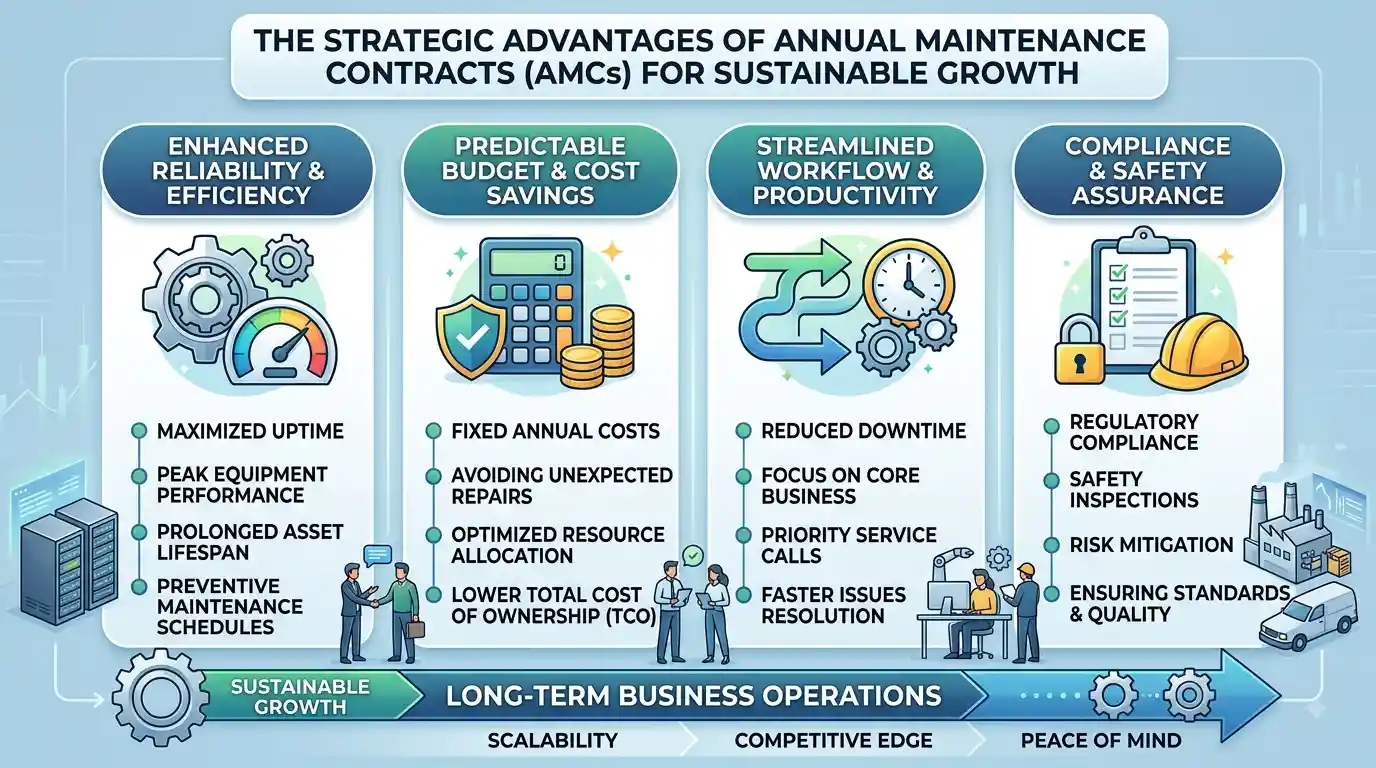
An Annual Maintenance Contract can support this objective by combining scheduled inspections, preventive servicing, technical assistance, and ongoing maintenance documentation.
Rather than treating every equipment issue as an isolated event, businesses can use maintenance information to develop a broader understanding of asset performance.
This approach can contribute to more predictable operations and better resource planning.
Final Thoughts
Long-term business success depends partly on the reliability of the systems and assets that support daily operations. Delayed maintenance can increase the risk of breakdowns, unexpected expenses, and operational disruption.
An Annual Maintenance Contract provides businesses with a structured way to manage these responsibilities throughout the year. Regular servicing, professional inspections, maintenance records, and ongoing technical support can help companies protect valuable assets and make more informed maintenance decisions.
The most effective approach is to choose a provider whose expertise matches the business’s equipment and whose service agreement clearly defines responsibilities and coverage.
When maintenance becomes a planned part of business operations rather than an emergency response, companies can create a more organized, reliable, and sustainable approach to managing their assets.
Related Reading: 廣汽埃安AION Y PLUS大空間如何改變汽車生活
Related Reading: Schengen Visa Support and Processing for UAE Residents — full guide
Related Reading: كيف أصبحت العملات المشفرة بهدوء المحفظة اليومية في الخليج — full guide